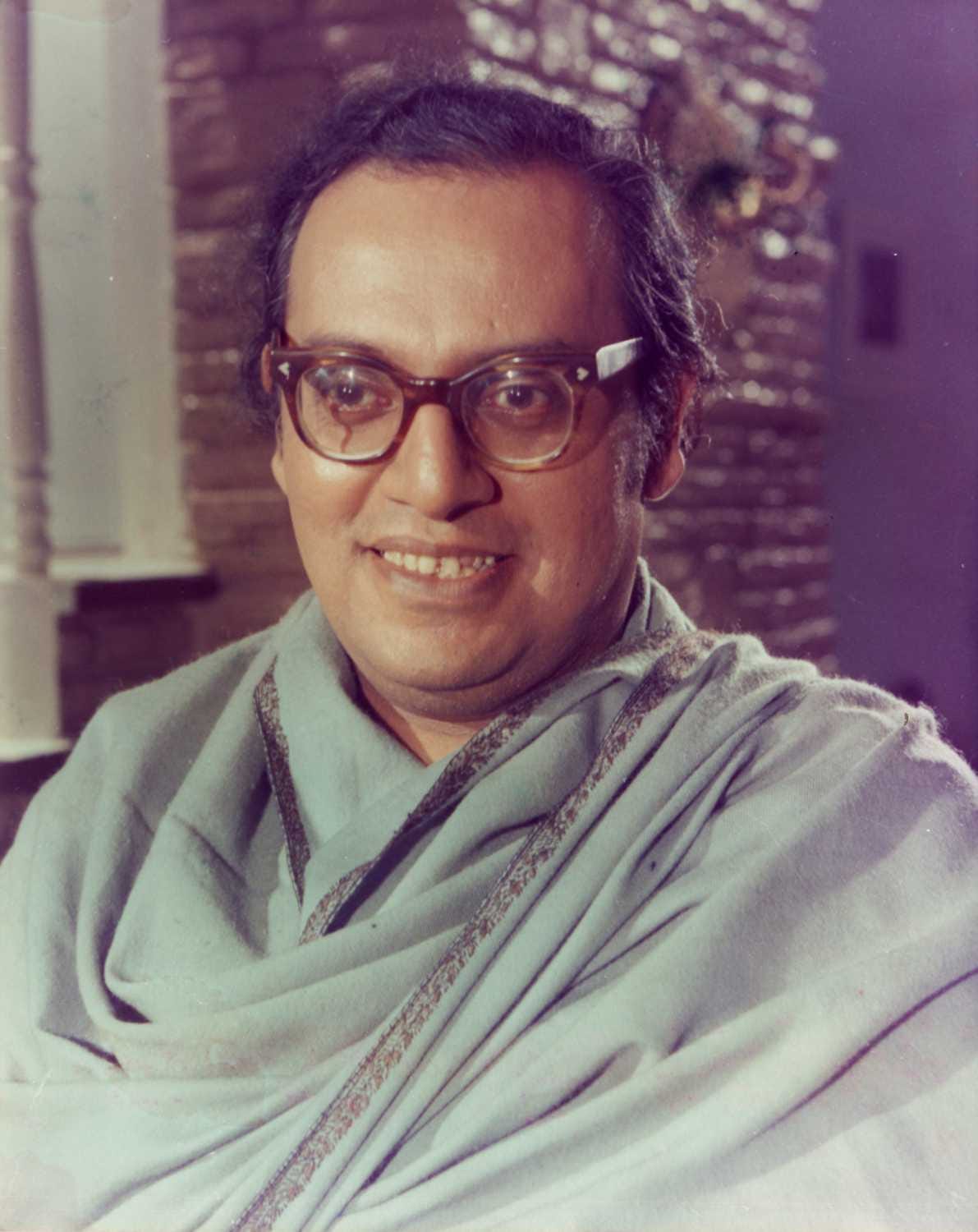
Few Indian performers built a career as expansive as Utpal Dutt.
He was a Shakespearean actor, playwright, theatre director, political dramatist and film performer who moved between Bengali theatre, parallel cinema and mainstream Hindi comedy without ever becoming confined to one artistic identity.
For millions of Hindi-film viewers, he remains unforgettable as Bhavani Shankar in Gol Maal, the authoritarian employer whose obsession with moustaches became one of the most enduring comic performances of the late 1970s. Filmfare continues to identify his famous moustache dialogue as part of the film’s enduring cultural legacy. Filmfare’s retrospective on Gol Maal
For students of Indian cinema, however, Dutt represents something considerably larger.
His performance in Mrinal Sen’s Bhuvan Shome (1969) earned him the National Film Award for Best Actor. His collaborations with Satyajit Ray included Jana Aranya, Hirak Rajar Deshe and Agantuk. At the same time, his political theatre transformed the stage into a space for historical debate, social criticism and political engagement.
The Tuli Research Centre describes him as one of the influential figures in modern Indian theatre and cinema, noting that he worked in more than one hundred Bengali and Hindi films while simultaneously building a major theatrical career. Tuli Research Centre: Utpal Dutt Archive
That dual career is the key to understanding him.
Dutt did not move from theatre to cinema and leave the stage behind. Theatre remained the intellectual and technical foundation of his work. Cinema simply gave that theatrical discipline another medium.
His career ultimately became a bridge between Shakespeare and Bengali political drama, between Brechtian ideas and popular Hindi comedy, and between the cultural seriousness of parallel cinema and the mass appeal of commercial entertainment.
At-a-Glance: Utpal Dutt
| Fact | Details |
|---|---|
| Born | 29 March 1929, Kirtankhola, Barisal, British India |
| Died | 19 August 1993, Calcutta, West Bengal |
| Nationality | Indian |
| Years Active | 1947–1993 |
| Profession | Actor, playwright, theatre director, producer |
| Breakthrough | Shakespearean theatre, especially Othello; film breakthrough with Michael Madhusudan Dutt |
| Major Films | Bhuvan Shome, Gol Maal, Naram Garam, Rang Birangi, Agantuk, Padma Nadir Majhi |
| Major Theatre Works | Angar, Kallol, Tiner Toloar, Barricade, Janatar Aphim |
| Notable Accolades | National Film Award for Best Actor; three Filmfare Best Comedian awards; Sangeet Natak Akademi Fellowship |
| Signature Style | Powerful voice, theatrical command, intellectual characterisation and precise comic timing |
The archival record gives Dutt’s birth date as 29 March 1929 and his death date as 19 August 1993. The Tuli Research Centre’s main biography uses the same dates, although a separate metadata field on the archive contains a conflicting March 19 entry. Tuli Research Centre: Utpal Dutt biography and awards
Early Life & Formative Years
Utpal Dutt was born on 29 March 1929 in Kirtankhola, Barisal, then part of British India.
His early years unfolded during a period when Bengal was experiencing enormous political and cultural upheaval. The Bengal Famine of 1943, the growth of anti-colonial politics and the emergence of socially conscious theatre all contributed to the cultural environment that shaped him.
Education played a major role in Dutt’s development.
He studied at several schools before attending St. Xavier’s Collegiate School in Calcutta and subsequently St. Xavier’s College, where he studied English literature. The literary education mattered enormously because Shakespeare was not simply an author he admired. Shakespeare became one of the foundations of his theatrical training.
The Tuli Research Centre’s archive records his early interest in Shakespeare and his participation in school productions, followed by increasingly serious theatrical activity during his college years. Utpal Dutt archival biography — Tuli Research Centre
Dutt also read widely beyond Shakespeare.
His intellectual interests included European theatre, Bertolt Brecht, Marxist thought and major works of political and social philosophy. That combination would later produce an unusual artistic vocabulary: classical dramatic technique combined with political theatre.
The Bengal cultural environment was equally important.
The success of Bijon Bhattacharya’s Nabanna demonstrated that theatre could address famine, poverty and social crisis rather than simply reproduce conventional literary drama. The Indian People’s Theatre Association also demonstrated how performance could be connected to wider political and social movements.
Dutt absorbed these developments.
For him, theatre could entertain an audience while simultaneously forcing it to confront uncomfortable questions.
That philosophy remained central throughout his life.
The Breakthrough: Shakespeare and the Stage
Dutt’s professional theatrical career began taking shape in the late 1940s.
In 1947, he established a Shakespeare-focused theatre group, initially known as the Amateur Shakespeareans. The organisation staged Shakespearean works and gave the young actor an opportunity to develop both as performer and director.
One of the important early productions was Richard III, in which Dutt directed and performed.
The production brought him to the attention of Geoffrey Kendal, whose Shakespeareana Theatre Company was touring India.
Kendal recruited Dutt into the company.
The experience proved crucial.
Dutt toured extensively, performing Shakespeare before audiences across India and Pakistan. His stage work included Othello, a role that became closely associated with his early reputation.
The Shakespearean experience gave him rigorous training in projection, movement, voice and ensemble performance.
It also gave him something more important: an understanding of how an actor could command an audience without relying on cinematic close-ups.
That ability would remain visible decades later.
In 1949, his theatre group became the Little Theatre Group, which initially concentrated on English-language drama before increasingly moving towards Bengali productions and politically committed theatre. Tuli Research Centre: Utpal Dutt research archive
His first major film opportunity soon followed.
Director Modhu Bose saw Dutt’s performance as Othello and cast him in the title role of Michael Madhusudan Dutt, released in 1950.
Cinema had arrived.
But Dutt never allowed cinema to replace theatre.
Career Arc & Defining Works
The Little Theatre Group and Political Drama
The most important part of Utpal Dutt’s artistic career cannot be understood through filmography alone.
His greatest institutional contribution was his development of politically engaged Bengali theatre.
The Little Theatre Group initially performed Shakespeare and European drama, including works influenced by Bertolt Brecht. Over time, Dutt increasingly created Bengali-language productions dealing with class, colonialism, labour, political authority and historical conflict.
The Tuli Research Centre identifies this transformation as one of Dutt’s most significant contributions: helping turn Bengali theatre into a powerful medium of political and social engagement. Tuli Research Centre — Utpal Dutt Research Centre
Among his major theatrical works were:
- Angar
- Louha Manab
- Kallol
- Barricade
- Tiner Toloar
- Manusher Adhikar
- Maha-Bidroha
- Janatar Aphim
The most famous was arguably Kallol.
Premiered in 1965, the play dealt with the Royal Indian Navy Mutiny of 1946, transforming a historical event into politically charged theatre.
Its subject was controversial.
The production attracted government scrutiny and Dutt was imprisoned in connection with the political controversy surrounding the play.
The episode became part of the mythology of Dutt’s theatrical career, but its significance goes beyond biography.
Kallol demonstrated his belief that historical drama could speak directly to contemporary political concerns.
The past was not dead material.
It was ammunition.
Dutt later established People’s Little Theatre, continuing his work in politically engaged performance.
He also worked with forms of popular theatre including Jatra, helping extend politically conscious performance beyond conventional urban theatre audiences. Tuli Research Centre’s Utpal Dutt archive
Bhuvan Shome: The Actor Reimagined
Mrinal Sen’s Bhuvan Shome (1969) transformed Dutt’s cinematic identity.
He played Bhuvan Shome, a senior railway bureaucrat whose rigid existence is disrupted when he encounters a rural environment far removed from his bureaucratic world.
The character initially appears almost institutional.
He is formal.
He is isolated.
He is disciplined.
He is emotionally controlled.
Dutt plays these qualities without turning the character into a caricature.
That restraint is crucial.
The performance gradually allows humour and vulnerability to emerge. Bhuvan Shome’s encounter with a different social environment unsettles his carefully controlled worldview.
Dutt’s performance demonstrates the extraordinary adaptability of his theatrical technique.
On stage, he could dominate an auditorium.
Here, he works within the much smaller psychological space of the film frame.
The performance earned Dutt the National Film Award for Best Actor. The Tuli Research Centre records the award among his principal honours. Tuli Research Centre: Utpal Dutt awards and filmography
The film itself became an important landmark of Indian parallel cinema.
For Dutt, it established that his theatrical authority could be translated into sophisticated cinematic naturalism.
Satyajit Ray: A Different Kind of Collaboration
Dutt’s association with Satyajit Ray represents another important chapter.
Their collaborations included Jana Aranya, Hirak Rajar Deshe and Agantuk.
Ray’s cinema required an actor who could carry dialogue, social observation and intellectual ambiguity without turning every scene into theatrical display.
Dutt was unusually suited to that requirement.
In Hirak Rajar Deshe, he contributed to Ray’s political fantasy and satire.
In Jana Aranya, he appeared within Ray’s examination of urban middle-class morality and commercial survival.
But the collaboration reached its most interesting point with Agantuk (1991).
Agantuk: The Late-Career Masterpiece
In Agantuk, Dutt played Manomohan Mitra, an enigmatic traveller who suddenly returns to the family he left decades earlier.
The role is constructed around uncertainty.
Is Manomohan really who he claims to be?
Why did he leave?
What has he learned from decades of travel?
And what does his worldview reveal about the society he has returned to?
Dutt never provides easy answers.
Instead, he makes Manomohan intellectually seductive.
The character can be humorous one moment and philosophical the next. His observations about civilisation, tribal societies, modernity and human behaviour give the film much of its intellectual energy.
The role is particularly interesting because Dutt himself had spent his life reading, writing, travelling through artistic traditions and questioning established institutions.
Manomohan therefore feels almost tailor-made for his particular combination of theatre, literature and intellectual curiosity.
The Tuli Research Centre identifies Agantuk as one of Dutt’s major late-career performances and describes the character as an ageing globetrotter who returns home after a long absence. Tuli Research Centre: Utpal Dutt archive
It is one of the clearest demonstrations of how much Dutt could accomplish without theatrical exaggeration.
He simply talks.
And he holds the screen.
Gol Maal: India’s Great Comic Authority Figure
For another generation, however, Utpal Dutt is inseparable from Gol Maal.
Released in 1979, Hrishikesh Mukherjee’s comedy cast Dutt as Bhavani Shankar, the conservative employer whose worldview becomes increasingly absurd as the story develops.
Filmfare describes Gol Maal as one of the enduring Hindi comedies of its era and specifically identifies Dutt’s moustache dialogue as part of Indian movie folklore. Filmfare’s Gol Maal retrospective
The performance is an extraordinary study in comic seriousness.
Bhavani Shankar does not think he is funny.
He is completely convinced that his rules are reasonable.
That conviction is what makes the character hilarious.
Dutt’s comic timing comes from control rather than chaos.
He pauses.
He stares.
He lowers or raises his voice.
He reacts with disproportionate seriousness.
The audience sees the absurdity before the character does.
That gap produces the comedy.
Dutt won the Filmfare Award for Best Actor in a Comic Role for Gol Maal. Filmfare’s historical winners database records the award under the 1980 ceremony. Filmfare Awards — Complete Winners Database
The success of Gol Maal also established Dutt as a major Hindi-film comic performer.
But he did not become a comedian by abandoning his dramatic technique.
He brought the full discipline of theatre into comedy.
The 1980s: Comedy and Character Acting
The success of Gol Maal opened the door to a sustained Hindi-film career.
Dutt appeared in numerous comedies and character-driven films during the 1980s.
His important Hindi performances included:
- Naram Garam (1981)
- Shaukeen (1982)
- Rang Birangi (1983)
- Kissi Se Na Kehna
- Lakhon Ki Baat
- Kirana?
His roles varied considerably.
He could play an authoritarian patriarch in one film and a more sympathetic middle-class father in another.
Filmfare’s retrospective on 1980s middle-of-the-road Hindi comedy highlights Dutt’s role in films such as Rang Birangi, alongside performers including Amol Palekar, Farooque Shaikh, Deepti Naval and Deven Verma. Filmfare’s 1980s comedy retrospective
His awards during this period are particularly revealing.
He won Filmfare’s Best Actor in a Comic Role for:
- Gol Maal
- Naram Garam
- Rang Birangi
Filmfare’s official winners database records the Naram Garam victory under the 1982 awards and the Gol Maal victory under the 1980 awards. Filmfare Awards Winners Database
The awards confirmed something audiences already knew.
Dutt could make authority funny without making the character weightless.
The Craft: What Made Utpal Dutt Different?
The Voice
Dutt’s voice was one of his most powerful instruments.
It could sound commanding, threatening, philosophical or absurd depending on the role.
In theatre, the voice allowed him to reach large audiences.
In cinema, he learned to reduce its volume without losing its authority.
His comedy frequently depends on vocal certainty.
The character says something ridiculous as though it were an unquestionable law of nature.
That is Dutt’s territory.
Physical Economy
Dutt did not need constant movement to establish character.
A fixed posture could communicate authority.
A glance could express suspicion.
A pause could turn an ordinary sentence into a punchline.
His physical stillness often made his comic explosions more effective.
Intellectual Characterisation
Dutt approached characters through ideas as well as emotions.
He wanted to understand what a character believed.
That is particularly obvious in Agantuk, where the character’s worldview is almost as important as the plot.
It is also visible in Gol Maal, where Bhavani Shankar’s rigid social philosophy becomes the foundation of the comedy.
Theatre Discipline
Decades of stage performance gave Dutt an exceptional understanding of rhythm.
He understood when to accelerate.
He understood when to stop.
Most importantly, he understood when not to react.
That control became a major part of his screen identity.
Political Theatre
Dutt’s theatre cannot be separated from his political worldview.
The Tuli Research Centre describes his work as combining artistic innovation with political commitment and identifies his contribution to Bengali theatre as one of the central reasons for his lasting cultural importance. Tuli Research Centre — Utpal Dutt Research Archive
His theatre dealt repeatedly with:
- Colonial history
- Class conflict
- Labour
- Political authority
- Social inequality
- Religious politics
- Historical memory
He saw the audience as an active participant rather than merely a consumer.
Personal Life, Advocacy & Public Persona
Utpal Dutt married actress Shobha Sen, another important figure in Bengali theatre and cinema.
Their daughter, Bishnupriya Dutt, subsequently became a scholar of theatre and performance studies. The Tuli Research Centre records their marriage registration in 1961 and identifies Bishnupriya Dutt as their daughter. Utpal Dutt’s archival personalia — Tuli Research Centre
Dutt’s political commitments were unusually public.
He was associated with Marxist politics and consistently treated theatre as a vehicle for political and social argument.
That position shaped both the subjects he chose and the theatrical structures he developed.
His public persona was therefore very different from the carefully managed celebrity image that would become increasingly common in later Indian cinema.
He was first and foremost a theatre intellectual.
Cinema made him famous to a much wider audience, but theatre remained his primary cultural territory.
Awards & Major Recognition
Dutt’s honours reflect the unusual breadth of his career.
National Film Award
- Best Actor — Bhuvan Shome (1969)
The award recognised his performance in Mrinal Sen’s landmark film. Tuli Research Centre — Utpal Dutt awards archive
Filmfare Awards
Dutt received three Filmfare awards for his comic performances:
- Best Actor in a Comic Role — Gol Maal
- Best Actor in a Comic Role — Naram Garam
- Best Actor in a Comic Role — Rang Birangi
The Filmfare winners database confirms his victories for Gol Maal and Naram Garam, while the Tuli Research Centre’s consolidated biography records all three awards. Filmfare Awards Winners Database Tuli Research Centre — Utpal Dutt awards archive
Sangeet Natak Akademi Fellowship
In 1990, Dutt received the Sangeet Natak Akademi Fellowship.
The Akademi describes its Fellowship as its highest honour and reserves it for distinguished figures who have made outstanding contributions to music, dance and drama. Official Sangeet Natak Akademi Fellowship information
For Dutt, the honour was particularly appropriate.
Cinema may have made him a household name, but theatre remained the foundation of his artistic legacy.
Legacy & Cultural Footprint
Utpal Dutt died on 19 August 1993, aged 64.
By then, he had established a legacy spanning theatre, Bengali cinema and Hindi cinema.
His influence is difficult to fit into a single category.
A Theatre Institution
Dutt helped make Bengali political theatre a major cultural force.
He demonstrated that theatre could be historically informed, politically engaged and commercially accessible at the same time.
A Shakespearean Performer
His early Shakespearean career gave him a foundation in classical performance that remained visible throughout his life.
The discipline of Shakespeare remained embedded in his command of language, voice and physical presence.
A Parallel-Cinema Actor
His performance in Bhuvan Shome showed that he could adapt theatrical authority to the intimacy of cinema.
A Hindi Comedy Icon
Bhavani Shankar became one of the most recognisable comic authority figures in Hindi cinema.
The success of Gol Maal was not a temporary phenomenon. Filmfare continues to place the film among the landmark Hindi comedies of its period. Filmfare’s Gol Maal retrospective
A Satyajit Ray Collaborator
His work with Ray demonstrated his ability to inhabit intellectually demanding characters without sacrificing accessibility.
Agantuk remains particularly important because it allowed Dutt’s literary and philosophical qualities to dominate the performance.
A Performer Without a Fixed Persona
Perhaps the most remarkable aspect of Dutt’s career is that he never became dependent on a single character type.
He could be:
- A Shakespearean tragic hero.
- A political playwright.
- A bureaucrat.
- A patriarch.
- A comic authoritarian.
- A corrupt landlord.
- A political ruler.
- A mysterious traveller.
- A literary intellectual.
The Tuli Research Centre records his collaborations with filmmakers including Satyajit Ray, Mrinal Sen, Ritwik Ghatak, Hrishikesh Mukherjee, Basu Chatterjee, Goutam Ghose and James Ivory, alongside a filmography exceeding one hundred Bengali and Hindi productions. Tuli Research Centre: Utpal Dutt filmography and biography
That breadth explains why his reputation has survived across generations.
Selected Filmography Highlights
| Film | Year | Director | Significance |
|---|---|---|---|
| Michael Madhusudan Dutt | 1950 | Modhu Bose | Early landmark film role |
| Bhuvan Shome | 1969 | Mrinal Sen | National Award-winning performance |
| Saat Hindustani | 1969 | Khwaja Ahmad Abbas | Important Hindi-film appearance |
| Jana Aranya | 1976 | Satyajit Ray | Major Bengali character role |
| Gol Maal | 1979 | Hrishikesh Mukherjee | Iconic comic performance |
| Hirak Rajar Deshe | 1980 | Satyajit Ray | Political fantasy and satire |
| Naram Garam | 1981 | Hrishikesh Mukherjee | Filmfare-winning comic role |
| Shaukeen | 1982 | Basu Chatterjee | Popular Hindi comedy |
| Rang Birangi | 1983 | Hrishikesh Mukherjee | Filmfare-winning comic role |
| Paar | 1984 | Goutam Ghose | Parallel-cinema performance |
| Agantuk | 1991 | Satyajit Ray | Major late-career performance |
| Padma Nadir Majhi | 1992 | Goutam Ghose | Final major film performance |
The Tuli Research Centre’s consolidated biography lists these among Dutt’s notable works and records his collaborations across Bengali and Hindi cinema. Utpal Dutt filmography — Tuli Research Centre
Frequently Asked Questions
Who was Utpal Dutt?
Utpal Dutt was an Indian actor, playwright, theatre director and political theatre practitioner. He became one of the defining figures of modern Bengali theatre while also building a major career in Bengali and Hindi cinema. His most recognised films include Bhuvan Shome, Gol Maal, Naram Garam, Rang Birangi and Agantuk. Tuli Research Centre — Utpal Dutt biography
What is Utpal Dutt best known for?
Utpal Dutt is particularly remembered for Bhavani Shankar in Gol Maal, his National Award-winning performance in Bhuvan Shome, and his portrayal of Manomohan Mitra in Satyajit Ray’s Agantuk. His theatre legacy includes politically significant works such as Kallol and Angar. Filmfare’s Gol Maal retrospective
When did Utpal Dutt begin his acting career?
Dutt’s professional theatre career emerged in the late 1940s. He established a Shakespeare-focused theatre group in 1947 and later worked with Geoffrey Kendal’s Shakespeareana Theatre Company. His first major film role came with Michael Madhusudan Dutt in 1950. Tuli Research Centre — Utpal Dutt archive
When did Utpal Dutt die?
Utpal Dutt died on 19 August 1993, aged 64. His late-career work included Satyajit Ray’s Agantuk and Goutam Ghose’s Padma Nadir Majhi. The Tuli Research Centre records that his final screen appearance was in a 1993 television adaptation of Byomkesh Bakshi. Tuli Research Centre — Utpal Dutt biography
Why Utpal Dutt Still Matters
Utpal Dutt’s career cannot be reduced to the phrase “comic actor.”
Nor can it be adequately described simply as the career of a Bengali theatre legend.
He was both — and much more.
He began with Shakespeare.
He absorbed Brecht.
He developed politically committed Bengali theatre.
He wrote plays about history and power.
He worked with Mrinal Sen.
He became a National Award-winning film actor.
He made audiences across India laugh in Gol Maal.
He continued working with Satyajit Ray.
And near the end of his life, he gave Agantuk one of its defining performances.
The apparent contradictions are what make his career extraordinary.
Dutt proved that an actor could be intellectually serious without becoming inaccessible, politically engaged without abandoning popular entertainment, and theatrically trained without appearing artificial on camera.
His greatest legacy may therefore be the absence of a single legacy.
There was the stage Utpal Dutt.
There was the political playwright.
There was the Shakespearean.
There was the Bengali character actor.
There was the Hindi comic performer.
There was the Satyajit Ray collaborator.
And there was the unmistakable man behind all of them: an actor who understood performance as both craft and cultural argument.
That is why Utpal Dutt remains one of the most distinctive figures in the history of Indian theatre and cinema.